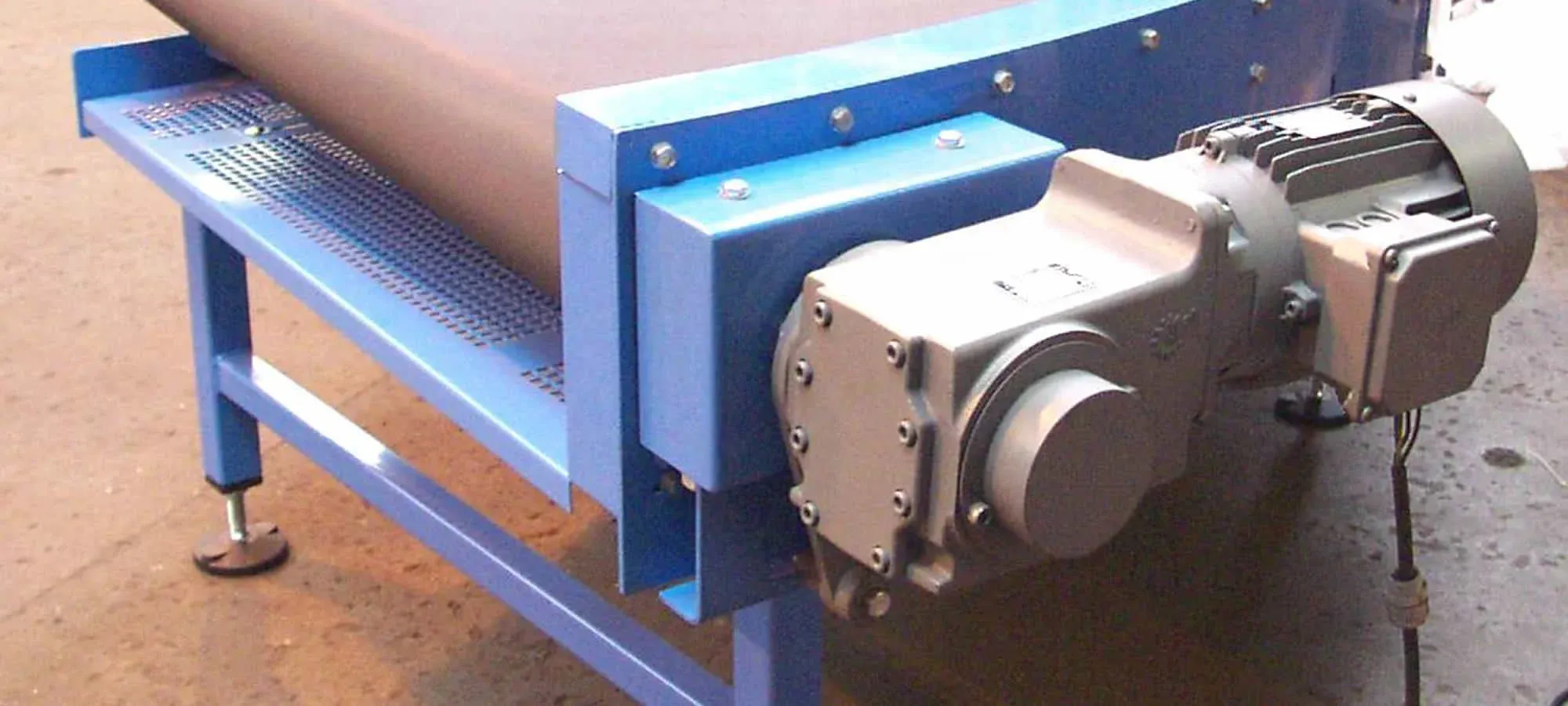
TR200 Hochleistungs-Gurtkurven für industrielle Förderanlagen
Die Schwerlast-Förderbänder der Serie Gramac Quartz TR200 sind für anspruchsvolle industrielle Förderanwendungen konzipiert, die eine hohe Tragfähigkeit und eine robuste Bandkonstruktion erfordern. Die TR200-Serie bietet eine Tragfähigkeit von 200 kg/m, gemessen entlang der Förderbandmittellinie (C/L), und ermöglicht die Montage dickerer Förderbänder um Endrollen mit einem maximalen Durchmesser von 200 mm.
Bei entsprechender Auslegung bieten dickere Förderbänder eine hohe Abrieb- und Schnittfestigkeit. Daher eignen sich TR200-Bogenbänder besonders für den Transport von unregelmäßig geformten Gütern wie Schrott sowie von scharfkantigen oder abrasiven Produkten wie Fliesen, Schiefer und Betonfertigteilen. Sie sind auch für Umgebungen mit hoher Staubbelastung, wie beispielsweise Kohleabfüllanlagen, geeignet.
Standard-TR200-Riemenkurvenabmessungen und -winkel
Die folgende Tabelle listet die Standard-Innenradien der TR200-Riemenkurve, die verfügbaren Bandbreiten und die entsprechenden Standard-Kurvenwinkel auf.
| Innenradius (mm) | Bandbreiten (mm) | Standardwinkel ( ° ) |
|---|---|---|
| 700 | 600 | 90°, 180° |
| 900 | 600, 800 | 90°, 180° |
| 1100 | 600, 800, 1000 | 90°, 180° |
| 1200 | 600, 800, 1000 | 45°, 90°, 180° |
| 1500 | 700, 800, 1000 | 45°, 90°, 180° |
| 1700 | 700, 800, 900, 1000 | 45°, 60°, 90°, 180° |
| 1900 | 800, 900, 1000, 1200 | 30° bis 180° |
Frequently Asked Questions About TR200 Heavy Duty Belt Curves
Gramac Quartz TR200 heavy duty belt curves have a maximum load capacity of 200 kg per metre, measured along the conveyor centre-line (C/L). They are designed for demanding industrial conveying applications where a higher load capacity and durable belt construction are required.
The TR200 design accommodates thicker conveyor belts around tapered end pulleys with a maximum diameter of 200 mm. When appropriately specified, thicker belts can provide increased abrasion resistance and cut resistance, helping the conveyor handle sharp, irregularly shaped or abrasive products. The belt material should be selected according to the conveyed product and operating conditions.
TR200 heavy duty belt curves are particularly suitable for conveying irregularly shaped, sharp or abrasive products when fitted with an appropriately selected belt. Typical applications include scrap metal, tiles, slates and cast concrete building products. They can also be used in industrial environments where abrasive dust is prevalent, such as coal bagging plants.
The TR200 range includes standard inner radii from 700 mm to 1,900 mm, with belt widths ranging from 600 mm to 1,200 mm. The available belt widths depend on the selected inner radius. Refer to the specifications table on this page for the standard size combinations.
Standard TR200 curve angles depend on the selected inner radius and belt width. Listed configurations include 45°, 60°, 90° and 180° angles, while the 1,900 mm inner-radius configuration is listed with angles from 30° to 180°. The table above identifies the standard angles for each size.
Published TR200 operating specifications include an ambient temperature range of -15°C to +55°C and a running noise level of 65 dBA or less, measured at 1 metre. The overall frame depth is 370 mm, with 315 mm from the top of the belt to the underside of the frame. The minimum specified pulley bearing L10 life is 50,000 hours. For further information, refer to the Belt Curve Technical Data and Specifications page.